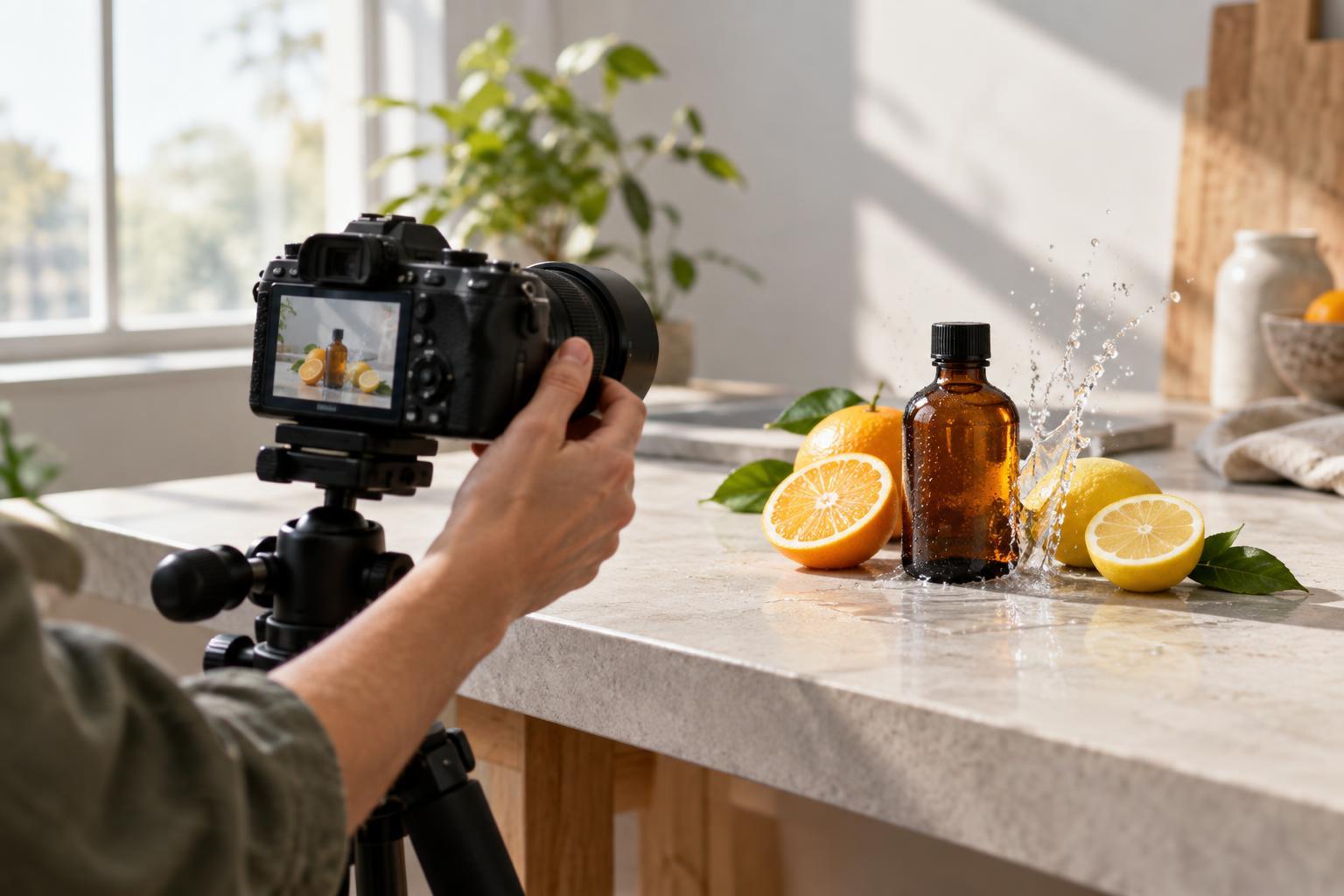
Start with the image’s purpose
A commercial photograph has a job. A product image may need to show its shape and details clearly. A portrait may need to make a person stand out from a busy workspace. A campaign image might leave uncluttered space for a headline. Before changing camera settings, decide what must look sharp, whether anything should appear to move, and where the image will be used.
Aperture, shutter speed, and ISO work together to control exposure: how bright the photograph appears. Changing one often means adjusting another to keep that brightness similar. But exposure is only part of the decision. Each setting also affects the image’s appearance, so the most useful question is not “What are the correct numbers?” It is “Which visual choice matters most for this brief?”
Aperture controls depth of field
Aperture is the opening in the lens that lets light through. It is written as an f-number, such as f/2.8 or f/8. A lower f-number means a wider opening and, generally, a shallower depth of field: less of the scene looks sharp from front to back. A higher f-number means a smaller opening and, generally, more depth of field. The effect also depends on factors such as lens choice and distance from the subject.
Imagine photographing a handmade cup for an online listing. If buyers need to see both its rim and handle clearly, start with an aperture that gives you enough depth of field, then inspect the image at full size. For an atmospheric image of the same cup on a café table, a wider aperture could soften the background and direct attention to the cup. Shallow focus is not automatically more professional; it is useful when the parts left soft are not essential to the message.
Shutter speed decides how motion appears
Shutter speed is how long the camera records light for a photograph. A short exposure can freeze movement; a longer one can show blur from either the subject or the camera. If you are photographing someone packaging an order, a fast shutter speed can keep their hands and the label legible. If you want to suggest activity, some blur in the hands may support the story, provided the important product details remain clear.
Camera shake matters even when the subject is still. A tripod can help with a stationary product when you need a longer exposure, but it cannot stop a moving subject from blurring. Take a test frame and check it closely, especially around text, edges, and faces. If the image will be cropped tightly for an advert, slight blur that seemed acceptable on the camera screen may become distracting.
ISO helps manage light, with a trade-off
ISO adjusts how the camera handles the light captured. Raising it can help you make a brighter image when the aperture and shutter speed are already set for the look you need. The trade-off is that higher ISO can make noise more visible and reduce fine detail or color quality, depending on the camera and conditions. There is no universal ISO limit: judge the file you have, at the size and in the format you expect to use.
For a product photographed in steady light, try a low ISO first and add light or use a tripod if necessary. For a person moving through a dim workspace, increasing ISO may be preferable to accepting a blurred face. A technically clean image is of little use if the subject is not sharp where the brief requires it. Conversely, a little visible noise may be less noticeable than a missed moment.
Choose settings in order of priority
Build a repeatable process around the subject. First, decide how much needs to be sharp and select an aperture. Next, decide whether motion must be frozen and choose a shutter speed. Then set ISO to reach a workable exposure. If the result is too dark or too bright, reconsider the setting with the least important visual effect, or change the available light. Camera priority modes can help while you learn: aperture priority lets you concentrate on depth of field, while shutter priority lets you concentrate on movement.
Before committing to a full set of images, photograph a test and review it beyond the thumbnail. Check the brightest and darkest areas, focus on the important detail, motion, and any empty space reserved for copy. Make one change at a time and note what it did. That habit turns aperture, shutter speed, and ISO from abstract camera terms into practical tools for making images that fit a commercial brief.